Learn how to measure for dog car stairs, check fit and stability, introduce each step without force, practise both directions, and keep vehicle entry separate from crash restraint.
Begin with the dog rather than the product. Watch the dog walk, turn, stand from rest, and approach an ordinary curb or low step. Pain, stiffness, lameness, a changed gait, reluctance to exercise, difficulty rising, or new trouble with stairs and jumping can be signs of osteoarthritis or another medical problem; Cornell advises veterinary examination rather than treating those changes as normal aging. A dog recovering from surgery, living with neurologic disease, losing vision, or showing severe weakness may need a veterinarian or rehabilitation professional to decide whether stairs, a ramp, a support harness, or assisted loading is appropriate. VCA notes that some mobility-compromised dogs should avoid unnecessary stairs altogether. Do not buy steps to make an unwilling or painful dog repeat a movement that a clinician has advised against. Car stairs are an access aid, not a treatment, a guarantee against falls, or proof that the dog is fit to travel.
Heeyoo
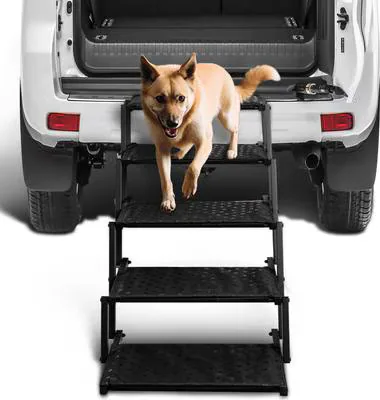
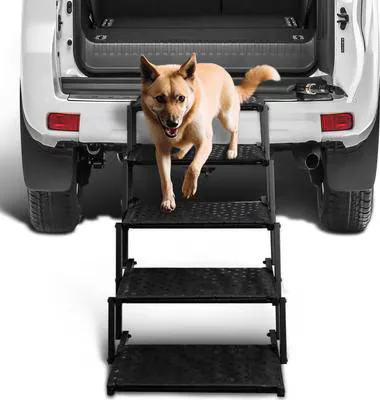
The standard Heeyoo five-step model measures 53 by 16.9 by 28 inches and combines a foldable metal accordion frame, rubber-coated treads, adjustable height, and a stainless-steel carabiner tether. Its 454 ratings provide the strongest product-specific public signal in this group, and its narrower frame may store more easily than the 19-inch extra-wide version. The exact page does not publish a weight capacity, so no load claim should be inferred from the related extra-wide model or another size. Hardware complaints and the absence of a verified vehicle-height range make careful measurement, inspection, and stable top attachment essential.

Park on firm, level ground, switch off the engine, engage the parking brake, and open the exact door or tailgate the dog will use. Measure vertically from the pavement to the real landing surface: cargo floor, back seat, truck bed, or another manufacturer-approved contact point. Pet Loader gives the same measurement instruction and uses different step counts for different height ranges, illustrating why a generic label such as four-step or five-step is not enough. Record the clear width of the doorway, the space between an open door and the vehicle body, bumper or sill shape, and the unobstructed ground available for the stairs at full deployment. Repeat the measurement if suspension height, parking surface, cargo load, or entry location changes. The Heeyoo Foldable Dog Car Stairs can represent a five-step format, but it should be considered only after its published deployment range and dimensions fit the measured vehicle rather than because a marketing photograph resembles it.
Pet Gear
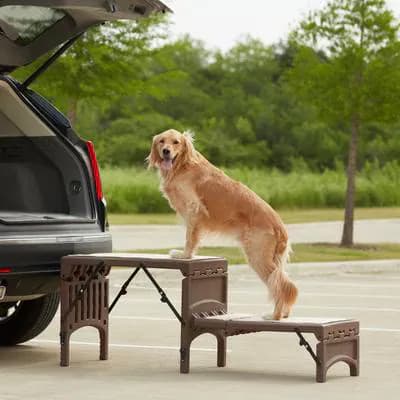
Pet Gear's free-standing staircase measures 60 by 19 by 23 inches, weighs 28 pounds, and carries a documented 350-pound maximum capacity. Raised side edges, rubber-grip legs, removable washable carpet, and a long self-supporting footprint distinguish it from hook-on accordion stairs. That capacity does not eliminate setup risk: the front, center, rear, and arm braces must all be opened and locked, and the long 60-inch body requires meaningful cargo space and lifting ability. It is a strong heavy-duty choice only when the vehicle sill height aligns with its 23-inch structure on level ground.
Compare the measured height with the exact model's permitted landing-height range and setup instructions. Then check platform width and depth, rise between treads, overall deployed length, product weight, folded dimensions, and the maker's stated capacity. The rated capacity must exceed the dog's current weight, but a large number on a listing does not prove stability at every angle or on every vehicle. A long-bodied, large, hesitant, or mobility-limited dog may need wider and deeper treads, while a side door can restrict the usable width even when the stairs fit a rear hatch. Confirm that the owner can lift, unfold, lock, and store the unit without dropping it or blocking the dog's travel compartment. Pet Gear Free-Standing Foldable Dog Car Steps offer a different freestanding geometry from an accordion ladder, which is useful only if the exact landing height, footprint, tread size, and load limit match. If no stair geometry permits a natural controlled stride, ask a veterinary professional whether a gentler ramp is more suitable.
Deploy the stairs without the dog present and follow the exact manual. Open every section fully, engage each lock, pin, knob, brace, or safety tether, and place the upper contact only on the solid location approved by the manufacturer. Make sure every lower foot is supported on dry, firm ground and the treads are clean and correctly attached. Pet Loader instructs users to place the top platform on the vehicle and the bottom platform on the ground, then secure its adjustment knobs; another design may attach differently, so never transfer instructions between models. Press each tread with a hand and then apply a gradual human test load while standing beside the unit, not on it, watching for rocking, sliding, folding, separation, or metal flex. Check hinges, rivets, welds, fasteners, fabric, traction panels, and any vehicle-contact pads for cracks, corrosion, looseness, contamination, or wear. Stop if the structure moves, a lock is uncertain, the landing is unsupported, or the model cannot be installed exactly as directed.
Start in a quiet, familiar area on a low-risk configuration allowed by the manufacturer. Let the dog look at and sniff the stairs without being pushed toward them. Reward calm attention, approaching, touching a tread, and placing one paw, then two, before asking for a complete ascent. AVSAB recommends reward-based methods for all dog training and rejects force, intimidation, pain, leash corrections, and flooding. Keep food small, deliver it where the dog can maintain balance, and use a calm marker word or click only if the dog already understands it. Sessions should be brief and end while the dog is relaxed. Never drag the dog by a collar, pull from above, push from behind, lift paws onto steps, shake the stairs, or punish retreat. Freezing, panting unrelated to heat, crouching, frantic scrambling, repeated escape attempts, or refusal to eat are reasons to reduce difficulty or stop, not evidence that the dog needs firmer handling.
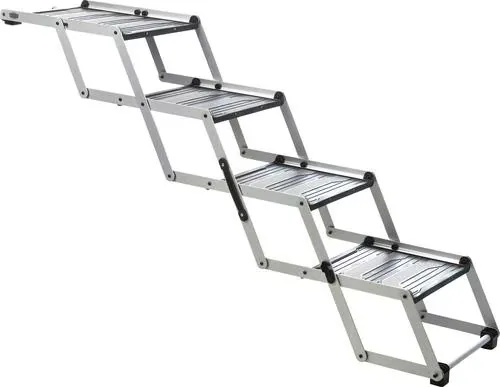
TRIXIE
TRIXIE's aluminum four-step model is listed at 43 by 14 by 32.25 inches, weighs 11 pounds, and supports up to 165 pounds. Chewy Q&A gives an adjustable top-step height of 23.6 to 27.6 inches and says it can be used at an SUV side entry. Its low carrying weight and eight-image gallery are useful for travel, but the 14-inch overall width and only four steps create a narrower, potentially steeper path than the leading five-step models. The size table's unusual 'recommended weight 76 lbs and up' should not be treated as a minimum dog weight or a fit guarantee without direct manufacturer clarification.
Dogs do not automatically understand that a successful climb means they can descend safely. Practise one direction at a time, beginning with one or two stable low steps or the least difficult approved setup. Stand alongside rather than directly above the dog. A correctly fitted walking harness and a loose leash may help prevent the dog from leaving sideways, but neither should haul the dog up, suspend body weight, or force the head and neck into position. Reward a slow paw placement on each tread and pause before turning around. Trixie Heavy Duty 4-Step Foldable Dog Stairs provide the third inline example because four-step geometry may suit a different landing than a five-step model; the dog's movement and the manufacturer's range still decide. Gradually add steps, height, and realistic distractions only after both directions remain controlled. If the dog jumps past treads, slips, rushes, repeatedly misses foot placement, or seems sore afterward, return to an easier setup and seek professional advice when the problem persists.
Move to the measured vehicle only after the dog is comfortable with the equipment elsewhere. Repeat the full deployment inspection, keep the engine off and parking brake engaged, and secure the open door or tailgate so it cannot swing into the dog or stairs. Use the same entry point and a familiar cue. Reward approaching the first tread, one or two steps, reaching the landing, turning safely inside, waiting, and descending on cue. A second adult can manage the vehicle area while the handler stays beside the dog, but no one should stand where a slip could trap a hand or foot. Block unsupervised access so the dog cannot leap around the stairs. Practise during daylight and dry weather before adding darkness, rain, travel excitement, or an unfamiliar parking surface. End immediately for rocking, loss of traction, panic, weakness, pain, or unsafe traffic. Training success on one vehicle and surface does not prove that a different height, doorway, campsite, or roadside shoulder is safe.
Once the dog is inside, prevent another exit, remove or fold the stairs exactly as directed, secure them as cargo, and close the vehicle before driving. Car stairs solve only entry and exit. They do not restrain a dog in motion, protect occupants in a crash, or turn an ordinary walking harness and leash into automotive safety equipment. Use a suitable, correctly fitted vehicle restraint or secured carrier according to its instructions, while recognizing that no product can make a collision harmless. After use, remove grit, mud, ice, salt, and moisture as the stair maker permits; dry traction covers and metal joints before storage. Recheck locks, feet, treads, fabric, welds, fasteners, and attachment points before the next trip. Retire or obtain manufacturer guidance after overload, a vehicle impact, a hard drop, structural deformation, torn traction material, corrosion, missing hardware, or any movement that cannot be corrected. Re-measure after changing vehicles, tires, suspension, cargo configuration, or the dog's mobility needs.
We used these primary or authoritative references when checking this guide. Product instructions and local rules can change, so confirm details that affect your trip.
Yes. It explains the main decision points in plain language and links to relevant product reviews when published options are available.
No. Prices, coupons, stock, and shipping terms can change. Confirm the current offer on the retailer page before checkout.
Related content