Learn what no-spill dog bowls can and cannot control, how to size and place one, how to introduce a floating plate or guarded opening without restricting water, and when changed drinking behavior needs veterinary attention.
Start by observing what actually creates the mess. A dog may push an ordinary bowl across the floor, step in it, tip it with a paw, plunge a long muzzle into the water, or carry water away on lips, beard, or ears. Vehicle and RV movement creates a different problem from enthusiastic drinking at home. A wide rubber base may resist sliding yet do little about splashing, while an inward rim may contain waves but still move when bumped. Keep the product promise in proportion: no-spill is a shopping term, not a guarantee that water cannot escape at any angle, fill level, speed, or impact. A bowl should reduce the specific mess without making clean water harder to reach. If a dog suddenly drinks much more, much less, coughs while drinking, or avoids a familiar bowl, treat that as a health or comfort observation rather than a product-review score and contact a veterinarian when the change persists or is concerning.
Road Refresher
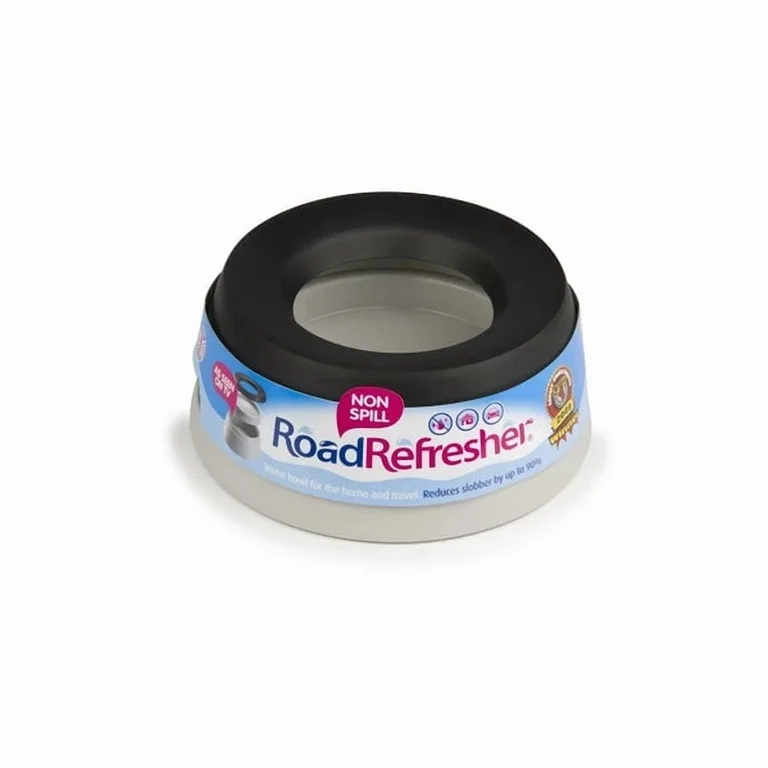
Road Refresher's large bowl stores about 1.4 liters or 54 fluid ounces beneath a floating plate that meters access to a smaller drinking surface. The brand documents a 242-millimeter base, 102-millimeter height, 120-millimeter drinking opening, toughened heat-resistant polypropylene, a hook-and-loop base, and extra fixing pads. This is the strongest travel-oriented candidate here for a stationary RV or parked vehicle where its base can be attached correctly. It is not leakproof: overfilling, an uneven surface, a loose fixing pad, hard vehicle movement, debris, or a stuck plate can release water or restrict access. Confirm free plate movement and a comfortable muzzle fit, clean every water-contact channel daily, and always carry a simple backup bowl and separate clean-water supply.
No-spill bowls use several distinct mechanisms. A floating plate exposes a small pool as the dog presses or laps, which can slow surface movement and reduce wet muzzles. A guarded opening or inward lip contains some waves and blocks paws from reaching the full water surface. A weighted, non-skid, suction, or anchored base mainly resists tipping and sliding; it does not automatically stop splash. Inspect the exact model diagram and instructions instead of transferring claims between designs. Check the approved fill line, whether the insert moves freely, and what happens if debris, ice, fur, or mineral scale obstructs it. The Road Refresher No Spill Pet Water Bowl is an example of a guarded, floating-plate format, not proof that every dog or journey will remain dry. Reject any design whose drinking path, assembly, cleaning instructions, replacement parts, or limitations cannot be verified. Even a well-designed bowl can leak after a hard bump, incorrect assembly, overfilling, or use on a steep or unstable surface.
Slopper Stopper
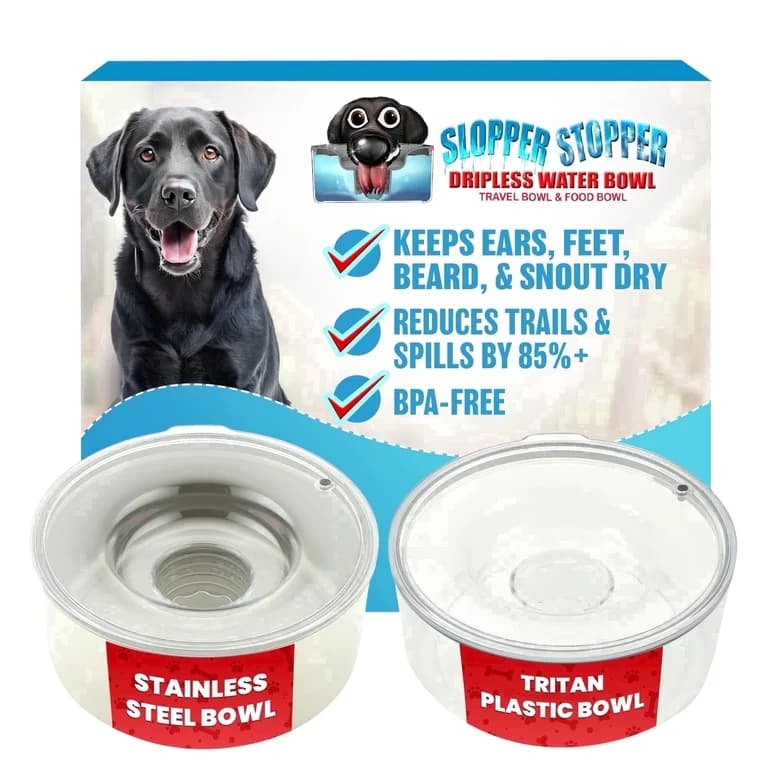
Slopper Stopper pairs a roughly one-gallon stainless bowl with a size-specific clear Tritan lid that limits access to a smaller drinking opening. The brand lists five lid sizes and describes the one-gallon body at about 9.84 inches in diameter by 4.19 inches high; the exact red lid is assigned to medium dogs weighing 21–50 pounds. The brand says its design can reduce spills and trails by 85% or more, but that is a manufacturer claim rather than a guarantee. Fit depends on muzzle shape, not body weight alone, and a narrow opening can be unsuitable for flat-faced, broad-muzzled, hesitant, elderly, or medically managed dogs. Introduce it beside a familiar bowl, confirm relaxed drinking and normal swallowing, clean the lid, seal, opening, and bowl daily, and never remove all alternative water to force adaptation.
Capacity alone cannot confirm fit. Measure the usable opening after every plate, rim, or guard is installed, then watch the dog approach an ordinary bowl in a relaxed standing posture. The dog should be able to reach water without forcing the nose, jaw, ears, neck, or tags against a narrow edge. Flat-faced dogs, large muzzles, long ears, facial hair, puppies, seniors, and dogs with dental, neck, vision, or mobility limitations may respond differently to the same opening. Confirm the water depth that remains accessible as the level falls; the advertised total volume may include water the dog cannot comfortably reach. The Slopper Stopper Dripless Water Bowl can serve as an inline example of a restricted-opening system, but its exact lid size and capacity still need to match the dog. Never choose a restrictive lid merely to keep a floor dry. If the dog cannot drink naturally or consistently, return to a familiar open bowl and reconsider the design.
Follow the manufacturer’s vehicle or RV instructions, because a household bowl is not automatically suitable for motion. Secure or stow the bowl before driving unless the exact product and installation instructions permit another setup. The safer routine is to stop in a legal, protected place, secure the vehicle, offer fresh water while the dog is calm, and stow loose equipment before moving again. Do not hold a container to a dog’s face in a moving vehicle, pour water into the mouth, or force rapid drinking; coughing, choking, repeated gagging, weakness, or breathing difficulty during or after drinking calls for prompt veterinary guidance. A no-spill bowl is not a crash restraint, a hydration monitor, or permission to leave a dog unattended in a vehicle. Pack a separate water supply and a simple backup bowl so a lost insert, blocked opening, crack, freeze, or cleaning problem cannot remove access to water.
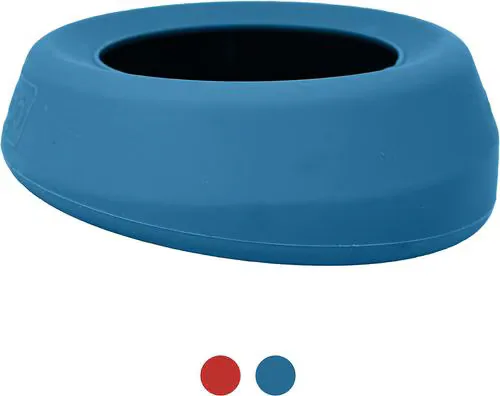
Kurgo
Kurgo's Splash Free Wander is a one-piece 24-ounce silicone bowl shaped with a wedge base so it can sit more level on a sloped vehicle seat. Kurgo and Chewy document a tapered edge, high sides, food-grade silicone, PVC- and BPA-free construction, a 7.3-inch diameter, a 2.75-inch height, and top-rack dishwasher care. It is the only first-three candidate with a verified brand-owned exact-model YouTube demonstration, and Chewy supplied seven exact static images plus a current direct reduction. Its design helps reduce movement-related splashing but is not a sealed or crash-proof container. Hard braking, sharp turns, low fill levels, a paw in the bowl, or incorrect placement can still cause water loss. Use a separate vehicle restraint for the dog, test placement while parked, refresh the water, inspect the silicone for tears, and do not treat the bowl as permission to leave a dog unattended in a vehicle.

A floating plate, narrow opening, sound, reflection, or moving part can be unfamiliar even when the bowl looks simple to a person. Begin at home in a quiet place while the dog is comfortable and not urgently thirsty. Put the new bowl beside the familiar clean bowl, add fresh water, and allow voluntary investigation. Reward calm approach if helpful, but do not push the muzzle, smear food into the water, hold the dog in place, or remove every alternative to force use. The Kurgo Splash Free Wander Water Bowl represents an inward-rim travel format with a different feel from a pressure plate; it should still be introduced before a trip. Watch for relaxed lapping, normal swallowing, and the ability to step away. Once the dog drinks comfortably, move the bowl gradually to its intended room, campsite, or stationary vehicle. Keep a familiar water option available during the transition, especially for puppies, seniors, medically managed dogs, and households where several animals share water.
USDA animal-care guidance emphasizes continuous access to potable water and specifically lists spill-resistant containers or anchored receptacles as ways to prevent loss. Fill with water that is safe to drink, check the actual level and drinking opening throughout the day, and refresh it when cloudy, warm, contaminated, or unappealing. Verify that a float or valve has not stuck and that every dog has unobstructed access. Heat, exercise, diet, medications, age, illness, pregnancy, and nursing can change water needs, so a bowl’s capacity is not a universal daily allowance. AAHA advises planning hydration during hot-weather activity; carry more water than the bowl holds and offer breaks appropriate to the dog and conditions. Do not use a no-spill mechanism to slow a dog whose drinking has changed without veterinary direction. A persistent rise or fall in intake, repeated vomiting, diarrhea, lethargy, abnormal urination, collapse, or suspected heat illness needs professional assessment rather than a different lid or fill line.
Reduced splashing does not make a bowl self-cleaning. CDC guidance says water bowls should be cleaned daily, and FDA safe-handling guidance calls for soap and hot water when cleaning pet bowls and utensils. Follow the exact manufacturer instructions first. Empty the bowl, remove the plate, rim, gasket, filter, valve, or reservoir only as directed, and wash every water-contact channel. Use a dedicated brush where fingers cannot reach, rinse away all detergent, and allow parts to dry before correct reassembly. Do not assume heat, bleach, or another disinfectant is safe for every plastic, seal, coating, or metal. If disinfection is appropriate because a pet is ill or a household member is at higher risk, follow CDC guidance, the product directions, and veterinary advice. Shared bowls may need more frequent attention. Biofilm, slime, odor, trapped food, hair, sand, and mineral scale are reasons to clean again, not evidence that a covered water surface can remain unchanged for several days.
Before refilling, inspect the bowl under good light. Look for cracks, sharp damage, chewed edges, warped plates, swollen seals, loose anchors, rust, persistent odor, cloudiness, and parts that drag or fail to return freely. Reassemble in the documented order, add water only to the approved level, press or move the drinking plate as intended, and confirm that water appears without sticking or sudden flooding. Test stability by nudging the empty and then filled bowl by hand on its real surface while the dog remains away; do not claim impact resistance from an informal test. Retire the unit or ask the manufacturer about replacement parts when damage, missing hardware, leakage, or unreliable flow cannot be corrected. Keep the ordinary backup bowl clean and accessible, and carry it on trips. The best no-spill bowl is the one a dog can use comfortably, an owner can clean completely, and the household can monitor reliably—not necessarily the model that makes the broadest promise or hides the most water.
We used these primary or authoritative references when checking this guide. Product instructions and local rules can change, so confirm details that affect your trip.
Yes. It explains the main decision points in plain language and links to relevant product reviews when published options are available.
No. Prices, coupons, stock, and shipping terms can change. Confirm the current offer on the retailer page before checkout.
Related content